OKX survey: 65% of Gen Z crypto investors expect to raise their share
Europeans in the poll of 1,932 investors chose cryptocurrency over retirement accounts as lasting wealth, 19% to 8%, while Americans favored retirement accounts, 21% to 12%.
- Some 65% of Gen Z and 63% of millennial respondents expect to raise their cryptocurrency share within five years, OKX said.
- Americans under 45 are keener to add: 70% expect a larger cryptocurrency share, against 57% of Europeans under 45.
- All respondents have invested in cryptocurrency before; the Federal Reserve found 10% of U.S. adults used it in 2025.
Share of crypto investors who expect to increase their crypto allocation over the next five years, %. OKX Insights 008, Pollfish survey of 1,932 investors, Oct. 14-18, 2026.
OKX said on Oct. 29 that 65% of Gen Z and 63% of millennial investors expect to raise the share of their portfolios held in digital assets over five years, in its OKX Insights 008 survey.
Pollfish interviewed 1,932 adults who have invested in cryptocurrency on Oct. 14-18: 1,000 in the U.S., 250 in France, 250 in Germany, 210 in the Netherlands and 222 in Poland.
Investors under 45 lead the plans to add digital assets
Across all ages, 51% expect a larger cryptocurrency allocation, OKX said. Boomers, aged 61 to 88 in the survey, stand apart: 55% say cryptocurrency is not at all important to generational wealth.
Americans under 45 are keener to add. Some 70% expect a larger cryptocurrency share, against 57% of Europeans under 45, a gap of 13 percentage points.
Among all U.S. respondents, 55% expect an increase, including 22% who plan a significant one. In Europe, the figures are 47% and 13%.
Weighted by sample size, those two figures give 51%, matching the all-ages result, by our calculation.
More than eight in 10 investors under 45 say cryptocurrency matters to building generational wealth: 87% in the U.S. and 84% in Europe.
Europeans rank digital assets above retirement accounts
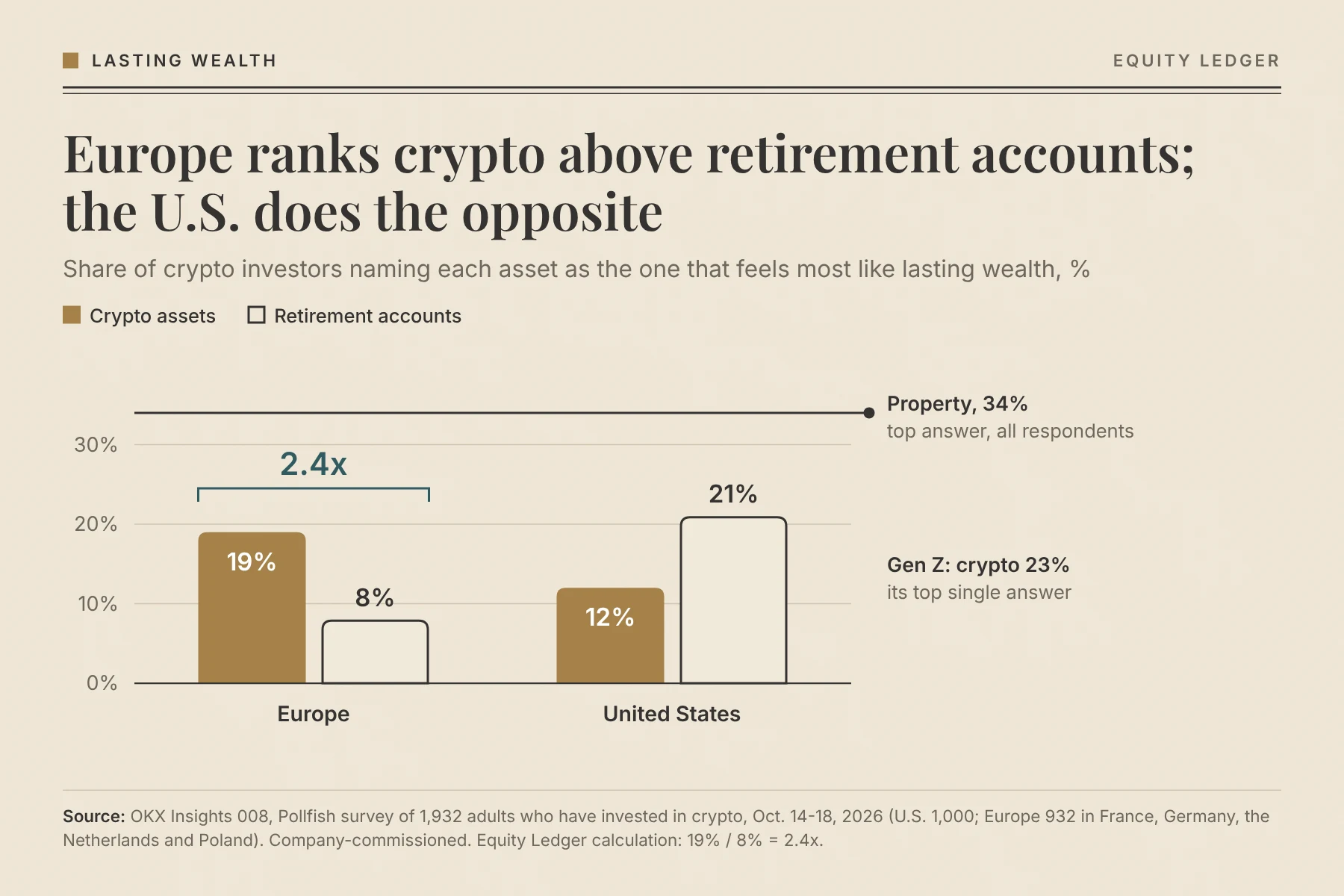
Property remains the top symbol of lasting wealth: 34% of all respondents chose land, property or real estate, ahead of digital assets and retirement accounts at 15% each.
In Europe, 19% named digital assets and 8% retirement accounts, 2.4 times as many. In the U.S., 21% named retirement accounts and 12% digital assets.
Among Gen Z, digital assets were the top single answer at 23%. Property still leads in every age group once land and real estate answers are combined, OKX said.
In the U.S., 61% of non-retirees had a tax-preferred retirement account in 2025, according to the Federal Reserve's household survey.
The Labor Department proposed a rule on March 31 on how 401(k) fiduciaries pick investments that lists digital assets among alternative assets. Comments closed June 1.
Legitimacy scores match while social standing splits
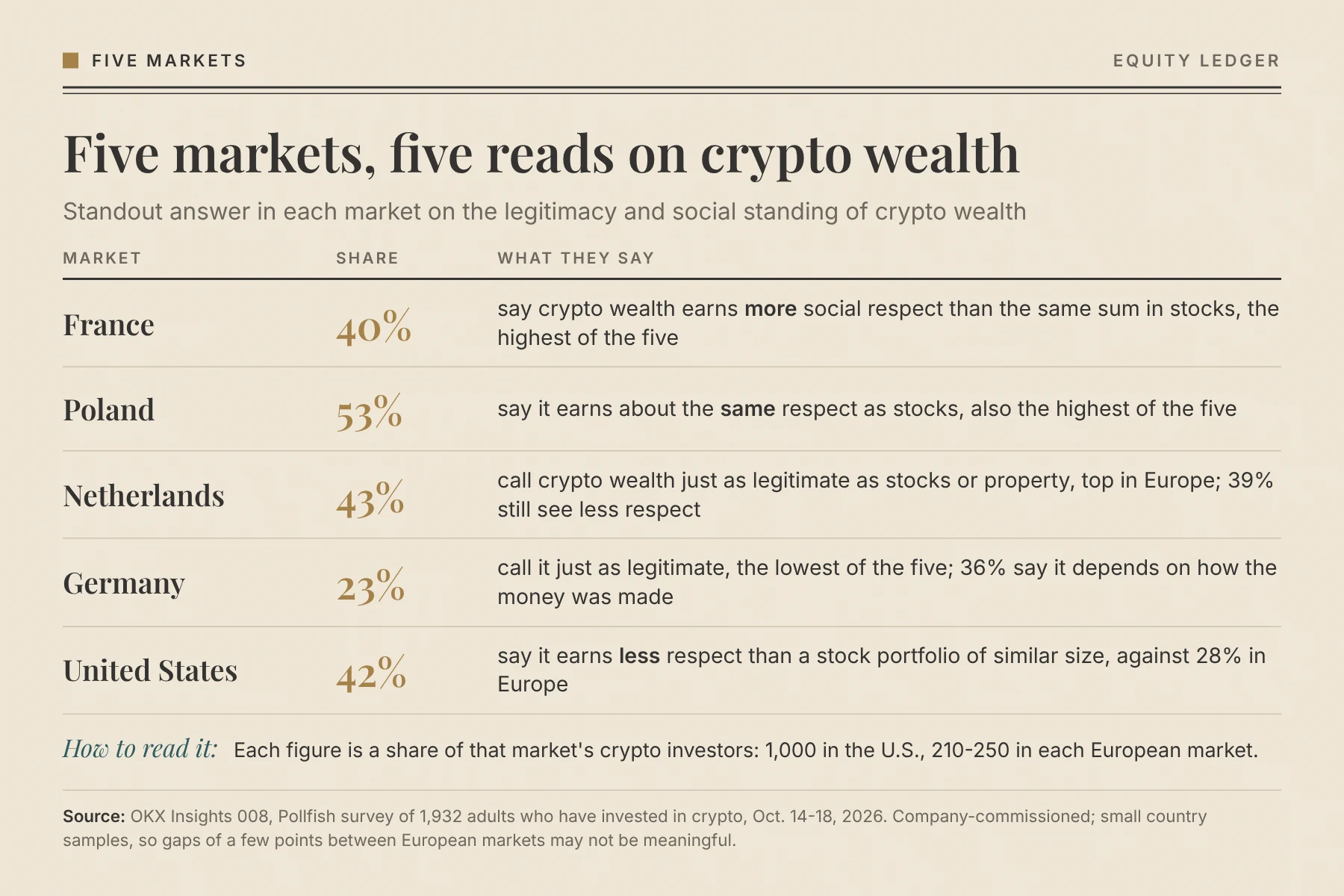
In both the U.S. and Europe, 34% of investors call cryptocurrency wealth just as legitimate as wealth built in stocks or real estate, according to OKX.
Only 23% of German investors call cryptocurrency wealth equally legitimate, the lowest of the five markets, while 36% say it depends on how the money was made.
Dutch investors are the most accepting in Europe, with 43% calling cryptocurrency wealth equally legitimate, yet 39% say it earns less respect than stocks.
In France, 40% say cryptocurrency wealth earns more respect than the same sum in stocks, the highest of the five markets. In Poland, 53% say it earns about the same, also the highest.
In the U.S., 42% say cryptocurrency wealth earns less respect than a stock portfolio of similar size, against 28% in Europe.
Most Americans put the bar for rich at $1 million or more
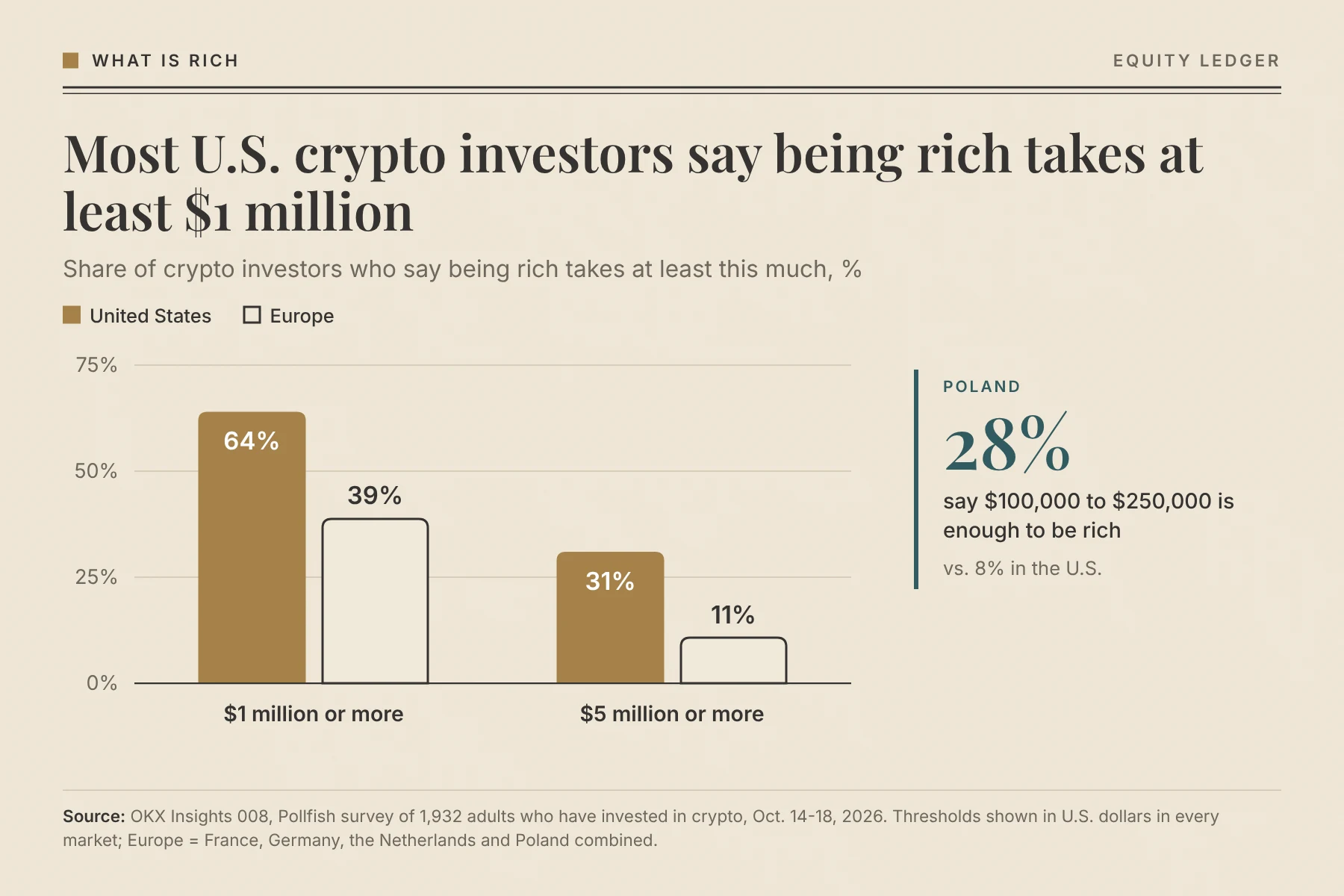
Some 64% of U.S. investors say being rich takes $1 million or more and 31% say $5 million or more, against 39% and 11% in Europe.
In Poland, 28% say $100,000 to $250,000 is enough, more than three times the U.S. figure of 8%.
"People don't plan the next 20 years around a fad," said Erald Ghoos, CEO of OKX Europe. Ghoos said he expects cryptocurrency's place in wealth plans to grow as these investors age.
Fed and ECB data show how small the surveyed group is
The OKX sample covers only people who have invested in cryptocurrency.
Some 10% of U.S. adults used cryptocurrency in 2025, up 2 percentage points from 2024 but below 12% in 2021, according to the Federal Reserve's 2025 household survey.
In the euro area, 9% of respondents owned cryptocurrency in 2024, up from 4% in 2022, the European Central Bank found in its payment-attitudes study, AFP reported. Germany stood at 6%.
Report in numbers
| Metric | Value | Period | Source |
|---|---|---|---|
| Gen Z expecting a larger cryptocurrency share | 65% | Next five years | OKX Insights 008 |
| Millennials expecting a larger cryptocurrency share | 63% | Next five years | OKX Insights 008 |
| All respondents expecting an increase | 51% | Next five years | OKX Insights 008 |
| Europe: digital assets vs. retirement accounts as lasting wealth | 19% vs. 8% | Fieldwork Oct. 14-18, 2026 | OKX Insights 008 |
| U.S.: retirement accounts vs. digital assets as lasting wealth | 21% vs. 12% | Fieldwork Oct. 14-18, 2026 | OKX Insights 008 |
| U.S. adults who used cryptocurrency | 10% | 2025 | Federal Reserve |
| U.S. non-retirees with a tax-preferred retirement account | 61% | 2025 | Federal Reserve |
| Euro area respondents owning cryptocurrency | 9% | 2024 | ECB, via AFP |
OKX Insights 008 polled 1,932 adults who have invested in cryptocurrency, Oct. 14-18, 2026. Fed and ECB figures cover all adults surveyed, not only investors.
What the survey does not show
OKX, which operates a cryptocurrency exchange and wallet, commissioned the survey. The answers measure intentions, not purchases, and the release gives no comparison with earlier years.
Pollfish recruits respondents through apps, websites and reward communities and calls its approach convenience sampling.
Country samples are small, 210 to 250 investors in each European market, so gaps of a few points between them may not be meaningful.
"Europe" means the four countries combined, and wealth thresholds were shown in U.S. dollars in every market.
OKX supplied the survey results under embargo, and they could not be independently verified.
Source: www.okx.com