NOWPayments' Kate Lifshits says providers, not merchants, should own payment follow-ups
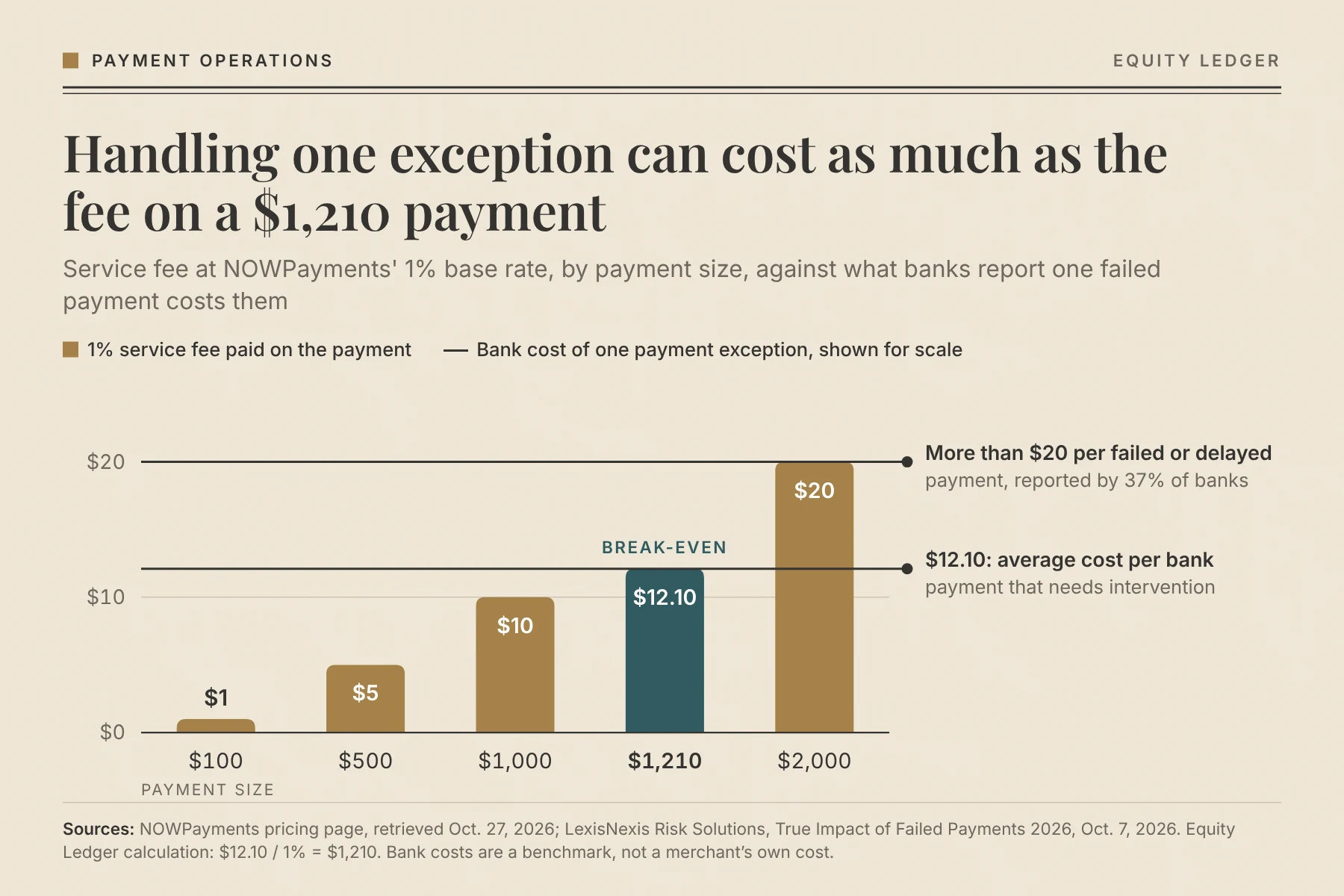
The processing fee shows on a statement while exception handling hides in payroll, and 37% of financial institutions in an October study put one failed payment above $20.
- NOWPayments' Kate Lifshits said payment providers should trace deposits and coordinate refunds so merchants handle fewer cases.
- Business and commercial programs made up about 17% of stablecoin-linked Visa card volume in fiscal 2026, Visa said.
- The OCC's final GENIUS Act rule for U.S. payment stablecoin issuers takes effect Jan. 18, 2027.
This story builds on BeInCrypto's Oct. 27 report on what failed cryptocurrency payments cost businesses.
Kate Lifshits, commercial director of cryptocurrency payment gateway NOWPayments, says the real test of a payment provider is how much exception work it takes off a merchant's team.
Her case comes as businesses start paying with stablecoins: business and commercial programs drove about 17% of stablecoin-linked Visa card volume in fiscal 2026, according to Visa.
Lifshits set out the argument in an Oct. 23 column, the second in her Crypto That Works for Business series, built on NOWPayments support cases.
The question she asks is who traces the deposit when a customer writes that a payment went missing.
NOWPayments was founded in 2019 by the team behind ChangeNOW, a cryptocurrency exchange service, and supports more than 350 currencies, according to its website. Its standard service fee is from 1% for single-currency payments, with lower rates for eligible partners.
Stablecoins move into business payments before U.S. rules start
Visa counted more than 160 stablecoin-linked card programs on Oct. 1, with payments volume up nearly 200% from a year earlier, the company said.
Research firm Allium, cited by Visa, estimates annual stablecoin payments at $401 billion to $527 billion.
"Businesses aren't looking for new payment technologies for the sake of innovation," Mark Nelsen, Visa's global head of product for commercial and money movement solutions, said in the Oct. 1 release.
The dollar tokens behind those payments slipped over the past month. Stablecoin supply stood at $299.19 billion on Oct. 27, down 1.23% over 30 days, according to DefiLlama.
The U.S. rulebook is set. The Office of the Comptroller of the Currency (OCC) issued its final rule implementing the GENIUS Act on Oct. 21, and both the rule and the law take effect Jan. 18, 2027.
The cost that never reaches the statement
Lifshits says the fee a merchant sees is only part of the cost, because the staff time that payment exceptions absorb rarely shows up anywhere.
"A processing fee appears on a statement. An afternoon spent tracing a deposit usually disappears into somebody's working day," Lifshits wrote.
Her advice is to look twice at a cheap fee that comes with that work. "A lower processing fee deserves a closer look if the arrangement leaves your team tracing transfers and chasing answers," she wrote.
The best recent price tag on that work comes from banks. In an Oct. 7 study of 150 payments executives, LexisNexis Risk Solutions found that 37% of financial institutions incur costs of more than $20 per failed or delayed payment.
Those institutions typically recover only $11 to $15 of it through fees, the study found. It put the average cost of a payment that needs intervention at $12.10.
The figures describe banks, not online merchants, a limit Lifshits flags herself. As a scale check, $12.10 equals NOWPayments' 1% base fee on a $1,210 payment, by our calculation.
Can the provider take a case end to end?
Lifshits says it should, and her own cases show where the merchant still has to step in. Her first rule is to check the original transfer before anything else.
"Asking for another payment before checking the original transfer risks creating a second reconciliation task," she wrote.
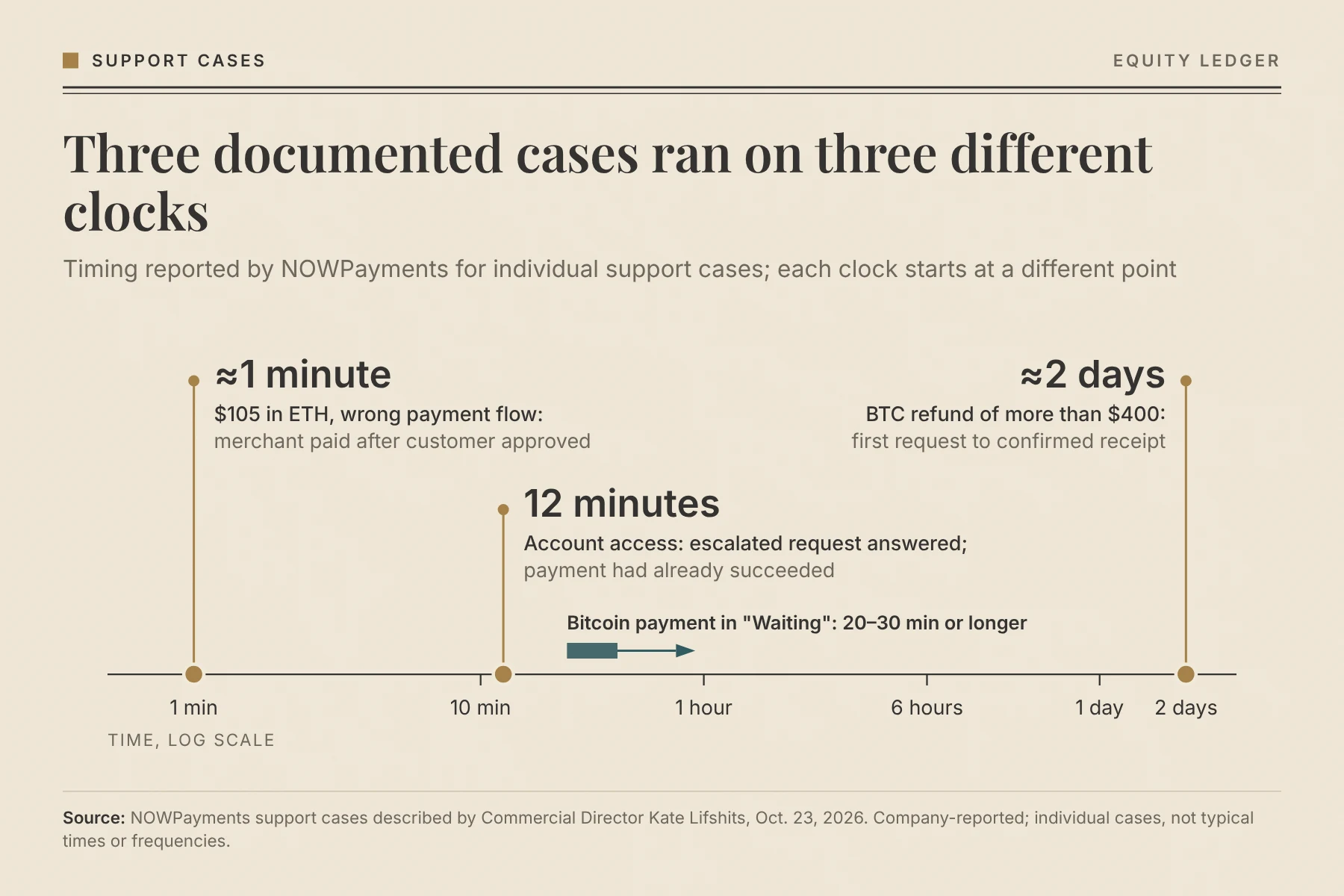
In one case she described, a customer sent $105 in ether through an incorrect payment flow. Support arranged manual completion, and the merchant received the funds about one minute after the customer approved.
A bitcoin payment worth more than $400 had shown as "Failed." Returning it took about two days from the first request to the customer's confirmation of receipt.
In a third case, support answered an escalated account-access request within 12 minutes and traced the problem to a different account email. The payment itself had gone through. Not independently verified.
"Grouping these cases under 'failed payments' or 'recovered sales' would obscure both the account issue and the refund," Lifshits wrote.
The cases are company-reported, and each clock starts at a different point. NOWPayments says the "Failed" status covered 0.07% of payments created from Jan. 16 to July 16, 2026, a snapshot that measures neither losses nor recoveries.
Bank payments offer a rough benchmark. One in 10 cross-border bank payments fails on its first attempt, according to the LexisNexis study; the two figures measure different systems and different things.
Fast first replies, fewer handoffs
NOWPayments reports that 97% to 98% of chats are picked up within three minutes and 98% to 99% of emails within 20 minutes, against a 95% target for both. Lifshits treats that speed as the smaller part of the job.
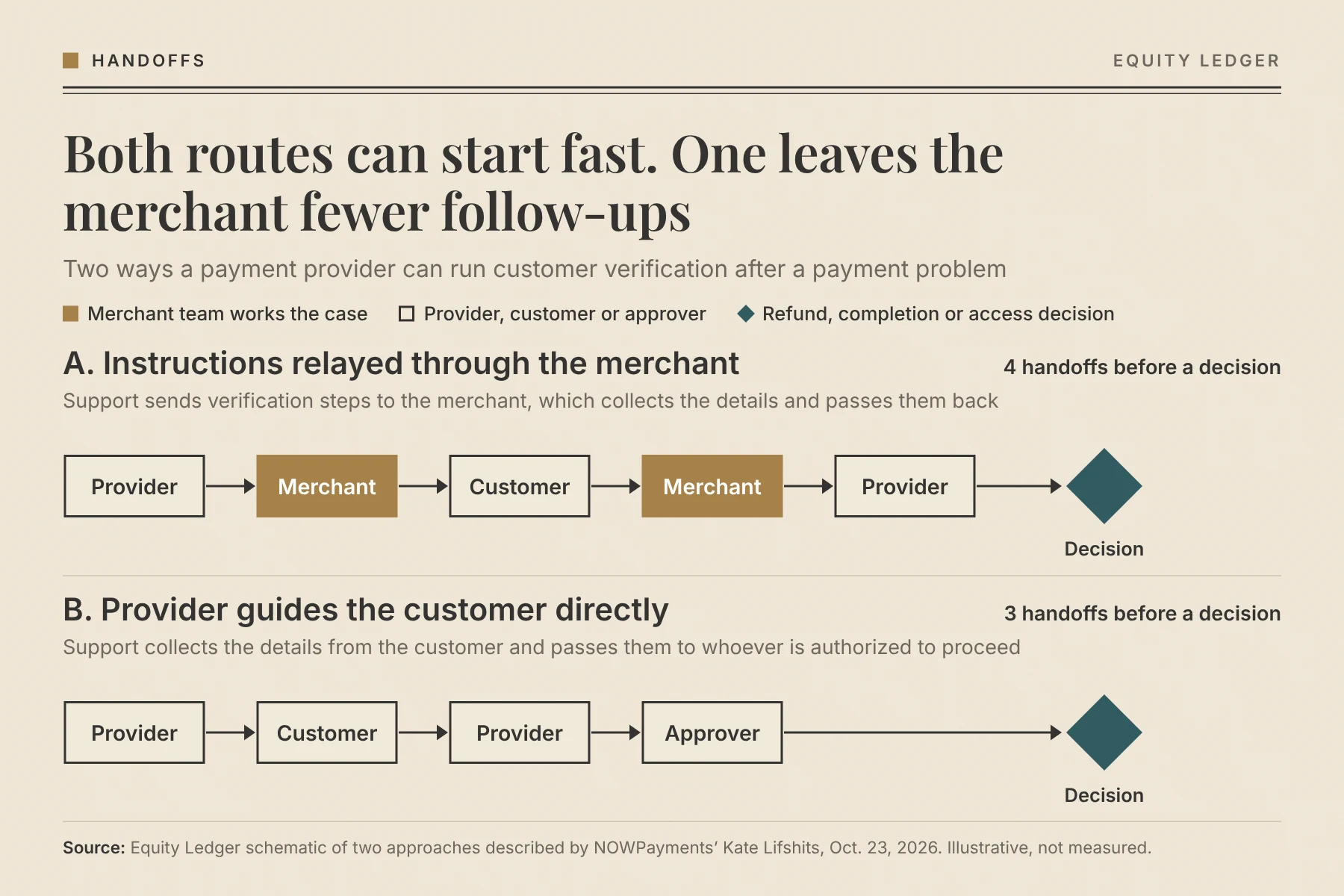
"Sending the merchant verification instructions leaves it to collect the details and relay them back," she wrote. Guiding the customer through verification directly, she argued, leaves the merchant fewer follow-ups.
"If your staff still chase every update and explain every next step, a fast first response has addressed only a small part of the task," Lifshits wrote.
The response figures are team-reported ranges covering about 12 to 18 months, the company said. They stop the clock at the agent's greeting and say nothing about how long a fix takes.
Lifshits also weighed in on AI in support. The study she cites, by Erik Brynjolfsson, Danielle Li and Lindsey Raymond, tracked 5,172 customer support agents.
AI assistance raised issues resolved per hour by 15% on average, the study found, and less experienced agents improved both the speed and the quality of their work.
"I would judge the benefit by whether that assistance helps a person reach a reliable decision sooner, without creating corrections that the merchant has to chase afterward," she wrote.
The study covered a software company's support desk, not payments, and NOWPayments reported no AI deployment of its own.
Four questions to put to a provider before signing
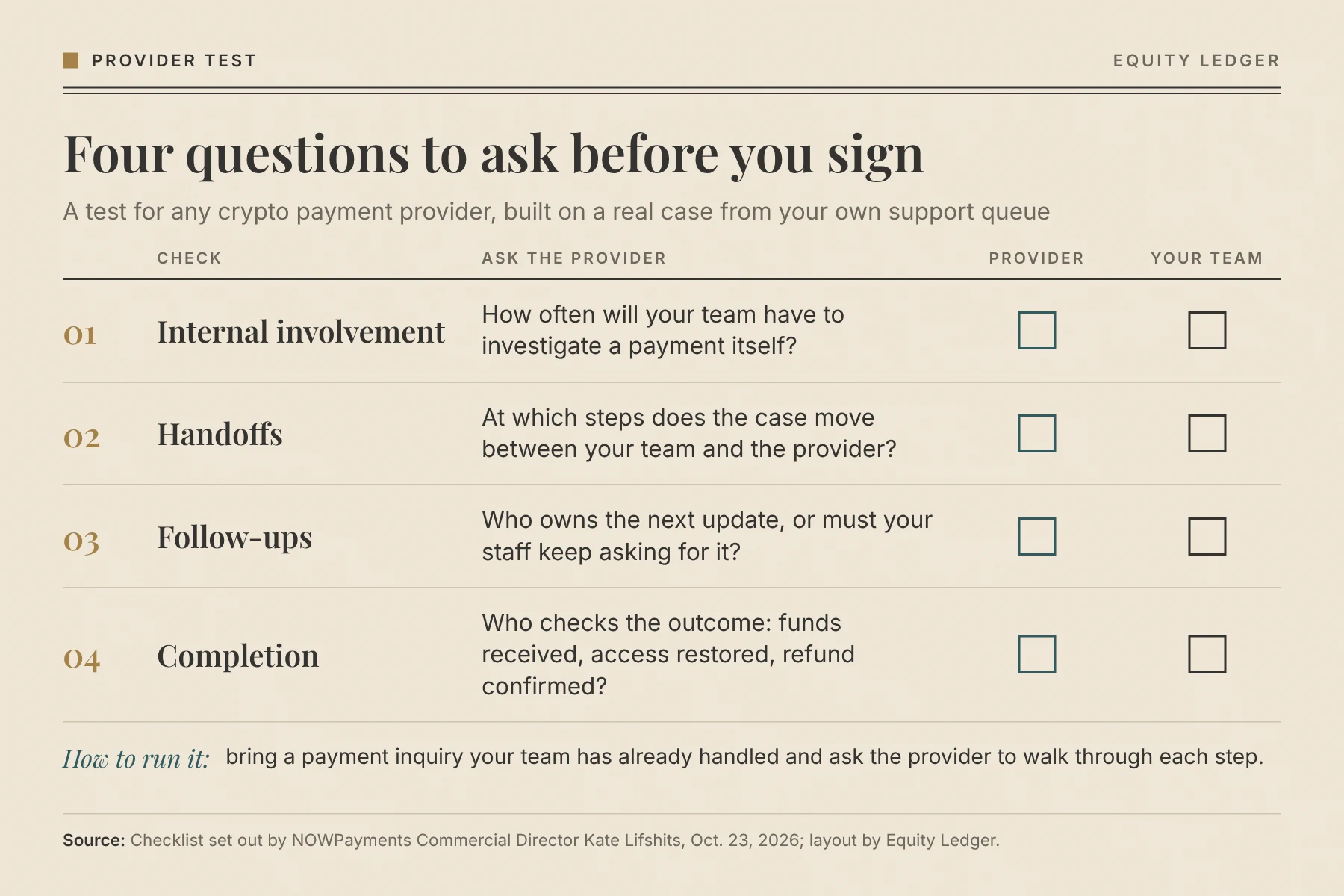
Lifshits closes with a test merchants can run before they sign. "Bring a payment inquiry your team has actually dealt with," she wrote.
Her checklist asks how often the merchant's team must investigate a payment itself, where a case changes hands, who owns the next update and who confirms the outcome, from funds arriving to access restored.
"Your payment volume should grow faster than your payment support workload," Lifshits wrote.
She concedes the benefit is unmeasured. Tracking a merchant's time and costs "would establish the size of the benefit," she wrote, and the column reports no measured merchant savings.
By the numbers
| Metric | Value | As of | Source |
|---|---|---|---|
| Stablecoin supply | $299.19 billion | Oct. 27, 2026 | DefiLlama |
| Business share of stablecoin-linked Visa card volume | About 17% | Fiscal 2026 to Oct. 1 | Visa |
| Stablecoin-linked card programs on Visa | More than 160 | Oct. 1, 2026 | Visa |
| Financial institutions with costs over $20 per failed payment | 37% | Oct. 7, 2026 | LexisNexis Risk Solutions |
| NOWPayments payments in "Failed" status | 0.07% | Jan. 16-July 16, 2026 | NOWPayments, company data |
| AI gain in support issues resolved per hour | 15% | Nov. 6, 2024 paper | Brynjolfsson, Li and Raymond |
The cheaper exception is the one that never happens
The LexisNexis research points to prevention as much as handling. Incorrect beneficiary information caused 21% of failed bank payments in the study, and account number and bank detail errors about 15% each.
Robin LoGiudice, strategic advisor at Datos Insights, which worked on the study, said the research shows that "many failures are instead linked to identifiable issues with payment data."
Vijay Nagarajan, director of market planning for payments efficiency at LexisNexis Risk Solutions, argued for validating data earlier, at payment initiation. In cryptocurrency checkout, Lifshits's own examples of such errors are wrong-asset and wrong-network transfers.
Her column centers on what support does after an error. It does not report how often NOWPayments' checkout stops one before it happens.
What to watch
The test of Lifshits's argument is a figure NOWPayments has not published: merchant staff time per payment exception. Published resolution times, rather than greeting times, would let merchants compare providers on the measure she proposes.
The regulatory clock is fixed. The GENIUS Act and the OCC rule take effect Jan. 18, 2027, when the federal regime for U.S. payment stablecoin issuers begins.
How we reported this: Lifshits's remarks come from her Oct. 23, 2026, column. NOWPayments supplied the support cases, the 0.07% figure and the response times, which we could not verify independently. Market figures come from Visa, DefiLlama, the OCC and LexisNexis Risk Solutions. The $1,210 figure is our calculation: $12.10 / 1%.